
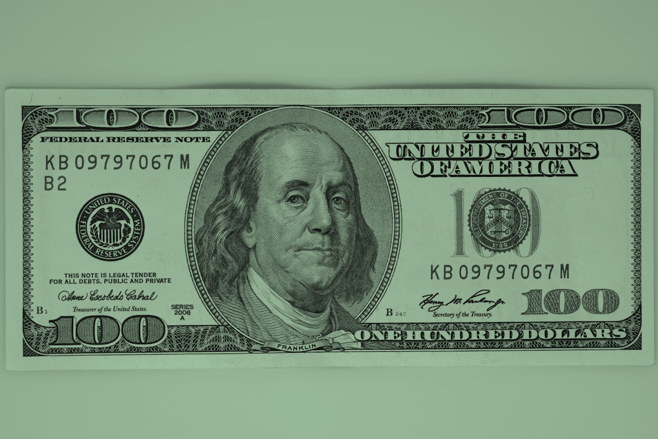
There is a troubling pattern between US invasions, and when oil states stop trading in dollars. After 20 years of trading oil in dollars, Iraq’s Saddam Hussain switched to euros in the year 2000. Two years later, he was overthrown and killed by the USA. Following 40 years of selling oil in dollars, Libya’s Gaddafi floated the idea of switching to gold dinars. Same story, overthrown and killed by the USA.
Since the 2008 financial crisis, Iran has also taken steps to diversify oil sales away from US dollars too. They have not completely stopped. Sure enough, relations are tense with the USA striking down nuclear facilities and branding government groups as terrorists.
Oil states don’t want to trade in US dollars
It seems to be an open secret that switching away from dollars will antagonise the beast. But trading in dollars doesn’t benefit the sellers.
Because of the USA’s wildly unsustainable deficit problem and cheerful approach to just printing more notes, the value of a dollar is decreasing all the time. And when you’re talking big numbers like in the oil industry, it hurts. A lot. The only real thing keeping dollars strong are that the rest of the world trades in them and stores them up in central banks.
But the dollar is not like gold. It’s not a great reserve currency to have. Oil states are losing money, hand over foot. To add salt to the wound, they know very well that while dollars are making them poorer, it’s making the USA wealthier. Which must be quite geo-politically annoying.
The USA relies on oil sales happening in dollars
Dollars officially replaced gold as the world’s reserve in the 1944 Bretton Woods agreement. There wasn’t enough gold left to buy things for the continuing World War II, or to rebuild after. So, a sort of trust-system was put into place, where everyone would just use US dollars instead.
French leader Charles de Gaulle was not invited (the UK and USA apparently were quite keen to ditch him from discussions for being a downer). And he was really, really, really NOT into the idea of the US dollar becoming the new gold.
De Gaulle claimed that the US would use its power “to be indebted to foreign countries free of charge” and then pay them back, “in dollars that they themselves can issue as they wish”. And that’s pretty much exactly what happened. For the best part of a century, the dollar has been propped up – not by the excellent saving and investing of the people – but by the reserve banks of other countries. They can borrow money incredibly cheaply, because even though it’s from other countries, they print it. They are the banker in Monopoly, everyone’s playing with their cash.
If this system was to collapse, so would the value of the dollar. Catastrophically. And the USA would fall into the kind of depression that makes 2008 look like a walk in the park.
So, US politicians (both sides Republicans and Democrats) are defending the petrodollar at all costs. They cannot let the party end on their watch.
BRICS and the rampant de-dollarisation trend
But the rest of the world has had enough, and de-dollarisation is happening. Back in the noughties, it was a bit sneakier. The USA set one hell of an example with Hussein and Gadaffi, so de-dollarisation was quite low-key. Quiet meetings between petro-leaders took place, shady handshakes happened, but on paper, it was all pretty dollar-y.
Everything changed with a bang following the Western sanctions on Russia in 2022. Forced out of the dollar-denominated sales, Russia has happily been trading oil in Chinese Yuan, Indian Rupee, UAE Dirham and its own Ruble. What happened? Umm… Nothing. Except that the oil states got a lot more confident. One committee made a massive comeback, BRICS.
BRICS’ manifesto is to “develop a settlement system independent of the US dollar”, and who’s in it? Well, it’s not just Brazil, Russia, China and South Africa anymore. There are now more than 30 applications to join (according to the website). Spurred by Russia’s de-dollarised success, 2023 alone saw the admission of big guns Saudi Arabia, Iran (the following year, the USA would strike Iran with missiles), the United Arab Emirates, Egypt, Ethiopia and Argentina.
Argentina later retracted its membership, when Milei because President. This is interesting. Because it led to Trump sending him $20bn (£15bn), to help “sway elections”. Trump is saying that he will not support a “socialist” president. But I think he is more focused on dollarisation. The message (as I read it) is, “keep trading in dollars, or we invade and force you to”.
Colombia officially joined the BRICS New Development Bank in June 2025. Last week Trump told President Gustavo Petro to “watch his ass”. Cuba joined BRICS in January 2025, now Trump is also threatening that the country will go down.
Oh yea… almost forgot. Another country applied to join BRICS in 2023 as well. Venezuela.
Venezuela’s application to BRICS and oil trade with China
Venezuela and Brazil have beef. This is one of the main reasons why Venezuela is not a fully-fledged member of BRICS already. But Maduro fit the part. After being slapped about with oil-related sanctions by the USA since 2017, he’d had enough.
On the 2nd August 2023, he stood up and said, “We are convinced that this new world order is already a reality”, he spoke of advancing de-dollarisation and obliterating the “indiscriminate use of the US currency as a mechanism of economic warfare against the free peoples of the world.” That is going to annoy the USA, a lot.
Venezuela’s approach to de-dollarisation was a little different from normal. He paid back China for loans in oil. This has been going on for some time, and was historically quite uncontentious (in 2015, Venezuela paid USD-denominated loans back to China in oil, and it was all hunky dory).
The issue starts when they stop using dollars. Honestly, I am struggling to find when (or if) that happened. Kasper Benajmin Reimer Bjørkskov assets that it was 2018. He writes, “And since 2018, Venezuela has sold 100% of its oil exports to China, with transactions settled in yuan, not dollars”. But I can’t find the source myself.
Today Chinese oil investors are left stranded (sustainable investing pun), as $10 billion-worth of loans are due in oil-form. Bjørkskov also points out that in the same period as the USA’s abduction of Maduro and his wife, Chinese bonds performed better than the higher-rated US versions, which further shakes-up the de-dollarisation trend. He believes this triggered the military action, and I think it sounds about right too.
Sure enough, the USA has taken over Venezuelan oil and is back to selling it in dollars. Who could have guessed?
What now?
If I was leading a petrol-exporting country, I would be super cautious about suggesting anything to do with BRICS or de-dollarisation right now. It is a touchy subject, leading to some massive geopolitical overreactions.
Looking more closely at the sovereign nations that Trump has his “drill baby drill” eye on, they are rich in commodities. Gaza. Greenland. Colombia. Cuba. Does he want the oil really? Or does he just want to make sure that the oil is sold and traded in dollars?
Zooming out, dollarisation also offers a hint as to why US politicians are so keen to delay the renewable energy transition. If they can’t sell it in dollars around the world, then their economic scaffolding collapses. It’s self-denial for self-preservation. To accept that countries can make their own energy for free is a kind of dollar suicide.
Is it really too late to go back pre-Bretton Woods, to the gold standard? We might just save a whole load of wars and the entire planet.